
Conservation has typically been seen as protecting nature’s resources. The National Geographic Society describes it as the care and protection of Earth’s natural resources for the use and benefit of humans now and in the future. This is a great concept, and conservation methods have resulted in a wealth of policies, but conservation goes deeper than policy. Dr Jannes Landschoff, Shamier Magmoet and Lisa Beasley explain how they use film, education and community to inspire conservation.
A recent study on children’s desire to protect nature found that “a personal connection with nature is considered a core determinant for environmental protection and sustainable living”. As the famous French underwater explorer, Jacques Cousteau said, “People protect what they love.”
A film about connection
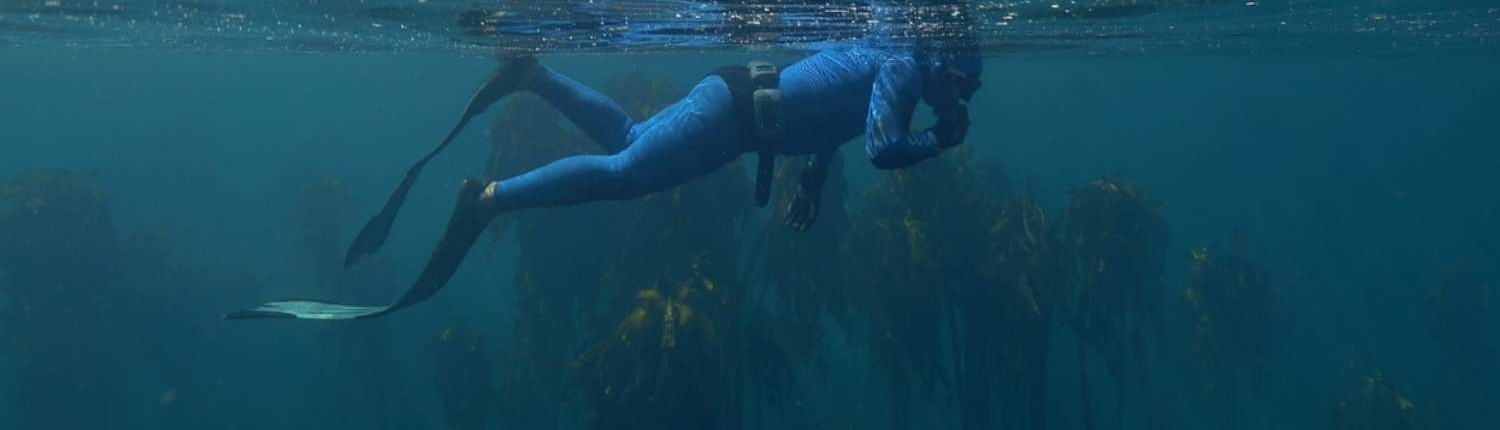
The Sea Change Project consists of a small team of scientists, storytellers, filmmakers and journalists, who go diving in what they’ve termed ‘The Great African Seaforest’. Their focus is on bringing attention to the beautiful kelp forests that line South Africa’s coast from De Hoop Nature Reserve to the border of Namibia. Their goal is to change people’s perception about kelp; to see it not as something rotting on the beach but as the precious Great African Seaforest. Holding their breaths, with no wetsuit to restrict them, the team glide between the kelp trees – cameras at the ready and the mind wide awake to capture the next story. In simple words, the Sea Change Project is a bunch of storytellers who bring light to a beautiful environment to inspire conservation. The team’s German-born marine biologist, Dr Jannes Landschoff says, “It’s science-informed storytelling.”
They recently released a film on Netflix titled My Octopus Teacher to great acclaim. The film tells the story of Craig Foster, co-founder of the Sea Change Project, who decides to dive every day for just under a year in the Great African Seaforest. The film documents the development of a friendship between Craig and an octopus. Time describes the film as a “viral sensation on Netflix” and few disagree with this statement, especially looking at the film’s 8.5/10 score on IMDb.
Landschoff, who was involved in this film project, says the work they do is about telling personal stories to connect people to nature. “Humans are social animals and they relate to other social beings,” he explains. “If there’s another human being with a story, they can relate to that story and when that person sees you in something like kelp then that value gets transferred to that person who hears that story.”

Dr Jannes Landschoff inspecting a king crab, related to his PhD research. Image supplied by Dr Landschoff.
Landschoff doesn’t believe the work they’re doing falls within ‘classical conservation’; he hopes it has a bigger impact on people. “Think about big places where conservation has been successful, look at the Yellowstone National Park. These places are places where people first fell in love with them, then started telling stories about them, and then wrote about them. So people knew about them and then a park was established around them. That’s always how it’s worked. Always about people noticing the value of a certain place; they start talking about it, tell stories about it and then those stories lead into protection measures over time.”
The work Sea Change is doing is contributing to a growing body of work in the field of ‘emotional ecology’. Emotional ecology aligns with what Dr Rachel Howell and Professor Jenny Pickerill write in their chapter from the book, Introduction to Human Geography, on giving an environment ‘inherent value’. Quoted from their chapter, this refers to “how we value something beyond its use as a resource but still relate value to how the thing makes us feel”. In short, we watch a film or experience nature, we connect to nature, we value it, we care for it, and then we want to protect it.
Education to inspire change
Shamier Magmoet has always had a love for the ocean; growing up in the violent and noisy Cape Flats he found silence near the sea. “I would use the ocean as an escape – a place where I could go find my silence.” Four years ago, Magmoet posted on his Facebook account inviting anyone to join him on a freediving course in order to get a discount on the price. A stranger at the time, Juneid Petersen, responded to his post and invited him to go diving with him. Magmoet slapped on a mask for the first time and his life was changed. “I saw the beauty the ocean held. I was scared the first time – I had the Jaws soundtrack in my head – but once I saw there was nothing out to get me, I just started seeing the beauty and that’s when I fell in love with the ocean.”
He also describes being very upset after his first freedive. “I thought to myself why didn’t anyone bring me to experience this? And that’s also the same day that I decided this is what I want to do… I want to show these youngsters that everybody can use the ocean, everybody can get that experience, and everybody can see why the ocean is important to us.” Magmoet than started to take his nieces and their school friends to snorkel in the tidal pools.
Chris Krauss and his wife, Tash, saw what Magmoet was doing and in 2018, joined with him to form Sea The Bigger Picture. The organisation focuses on coastal education and pollution awareness. To Magmoet, forming the organisation was about collective action. “We want people to see the bigger picture. It’s not about a bunch of individuals doing things by themselves, but when you work together with everyone else you will get bigger results.”
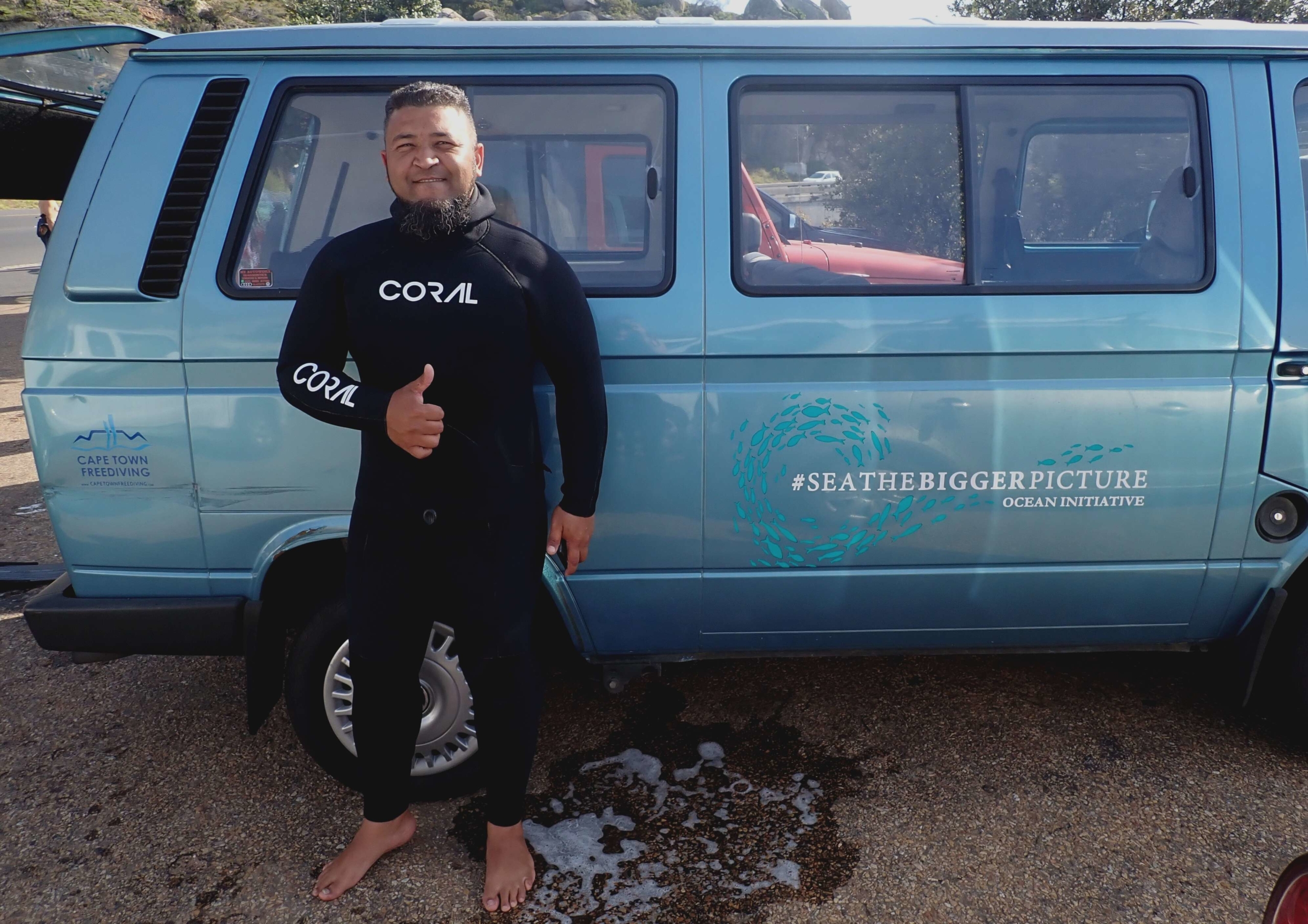
Shamier Magmoet lifts youth to the beach in his van, Big Blue.
Image: Anna Cocks
Now, Magmoet works for the City of Cape Town doing maintenance work during the week, and on the weekend he is running his ‘Defenders of the Blue’ programme, which involves introducing local youth to the ocean to inspire ocean conservation. The programme focuses on letting youth experience the ocean, especially those who don’t normally have access to it, and then educating them about its value.
To Magmoet, conservation means caring for animals, plants and for humans too. “I think the only time we really want to take care of something is when we love something,” he says. His time diving has improved his connection with nature. “It has made me want to protect nature much more, now that I’ve got the experience – I call it the full experience of the ocean.” His face simply lights up as he says this. So inspired by his experience, Magmoet has gone on to create a short film, Rise From the Cape Flats.
What happens when a community gets involved?
In 2016, Lisa Beasley moved to a block of flats opposite St. James tidal pool, Cape Town. She had spent the last 12 years as a commercial helicopter pilot for a geo-physics company in Central Africa. Before that, she had spent the three years learning how to walk after a BASE jumping accident where her parachute didn’t open-up fully and she ended up crashing into a cliff face. She moved to St James seeking a quieter lifestyle. She also wanted to freedive more after a friend, Pippa Ehrlich, had introduced her to the Great African Seaforest. “I thought kelp – ew, grey, brown and miserable,” she remembers. “Then once I saw what was here – I was blown away! Now I would take this over tropical any day,” says Beasley who had spent her off months diving in Indonesia while she was on contract as a pilot.
Beasley used the tidal pool as training to get acquainted with the cold water. “If you’re in that water it’s freezing, so the best thing to do is keep your monkey mind busy; otherwise you’ll go crazy.” Beasley would swim around and collect litter. She then began to notice the life that existed in the pool. She found octopi, cuttlefish eggs, nudibranchs and even a few small shysharks. It soon become like a treasure hunt for her. “It was about getting to the pool every day to see what I could find,” says Beasley.
She found the pool in the winter months when the City of Cape Town was more relaxed about cleaning the algae off the walls. They did this so people didn’t slip. She was horrified to be informed that as the summer months approached, the pools would be drained completely, and the walls would be sprinkled with copper sulphate or chlorine and scrapped with wire brushes – killing all sea life. Finally, the walls would be painted with lime wash mixed with copper sulphate. Once the pool filled up again due to the incoming tide, these harmful chemicals would wash into the ocean or some would be contained within the pool, posing a risk to human health.
“I think it had always been done like that and no one had questioned it. So, I freaked out and started calling people,” says Beasley. She got in touch with Helen Jordan from the City of Cape Town. Beasley explains, “I told her my whole sob-story. She was like, ‘Let’s at least try clean the top of the walls because that is immediate’. I said I will go do it. I will round up a whole bunch of divers and we will personally go scrape the tops so the walls are safe for walking. I will do that as often as you need me to do it. And let’s find a better way forward.”
She started posting what she had been seeing in the pools on Instagram and created a following and a community. “Instagram is cool like that. You can generate community and interest, and get information out quickly.” For the next couple of months, Beasley and her team of divers and pool-lovers alike maintained the pool.
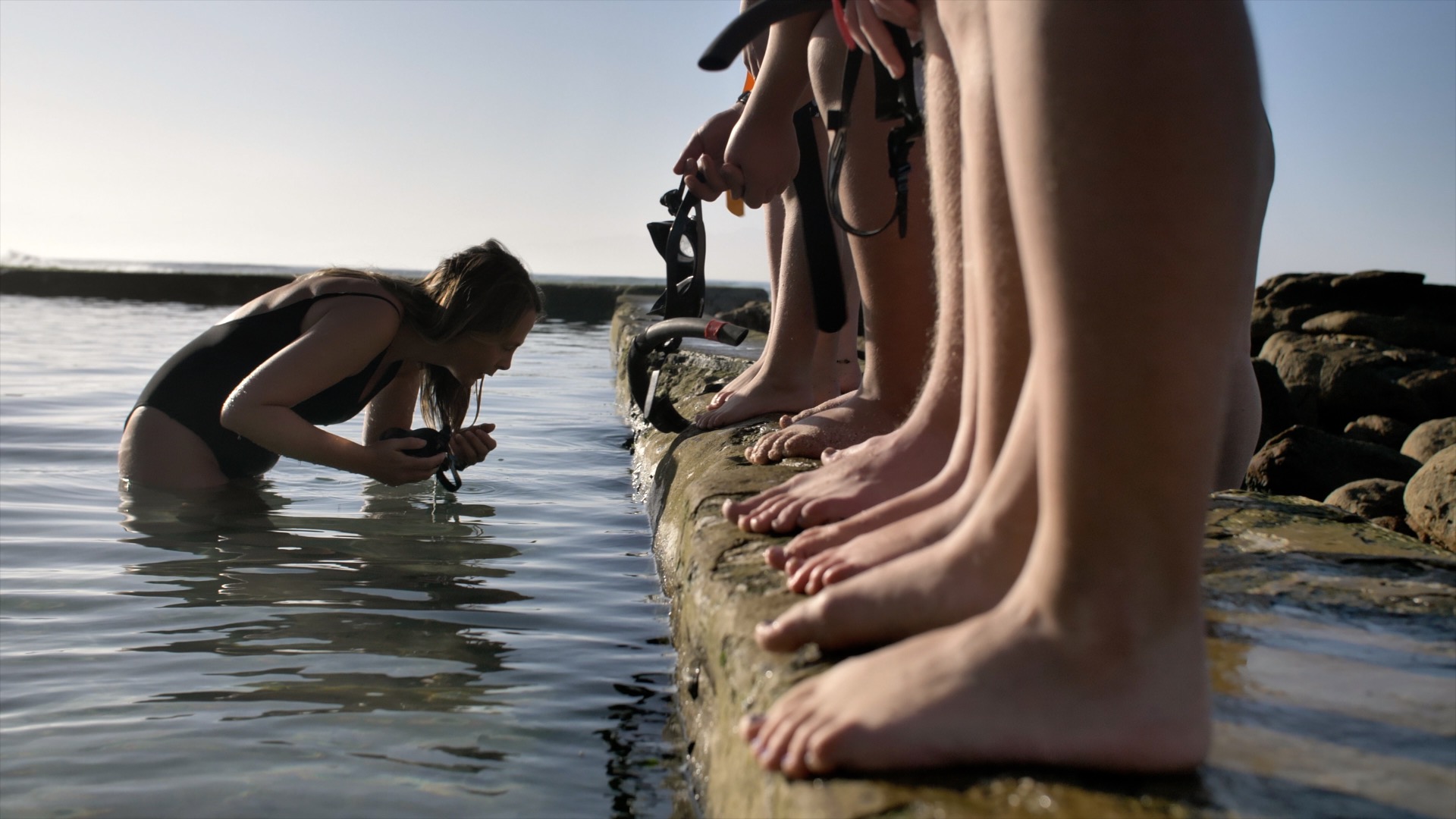
Lisa Beasley showing some interested followers the beauty of the St. James Tidal Pool, Cape Town.
Image by: Michael Carter
Beasley did some investigations into ways to clean pools in an environmentally friendly way. She contacted the Two Oceans Aquarium and they told her of their way of using saltwater and a high-pressure hose to clean the penguin enclosure. “It took a while to get the right pump that didn’t need electricity,” says Beasley. But one company put together a suitable pump, but it cost R30 grand. Getting funding from the City of Cape Town would take too long. “I’m an AA personality type who likes to get things done,” Beasley says. “So we did back-a-buddy crowd funding”. Along with her followers, enough money was raised in about two months to buy the pump which they donated to the City.
By the end of this year all 22 of Cape Town’s tidal pools will be cleaned on the new system designed by Beasley and her community. This is a small example of a community gathering around something they love in order to protect it. “Conservation is impossible without a deeper understanding and a passion or a love for something. You need those two things to be able to protect anything,” says Beasley. Quoted from her short film, Tidal, Beasley states, “It’s no secret. It’s no surprise that people will conserve what they love and people can only love what they understand.”